
The legend of Cinco Jotas: History and tradition in the heart of Huelva
In southwestern Spain, surrounded by the mountainous landscapes of the Sierra de Aracena and Picos de Aroche Natural Park, lies the town of Jabugo. This small municipality in the province of Huelva has become synonymous with the
The pinnacle of excellence in the world of ham. This is where the legend of Cinco Jotas ham was born, a brand that since 1879 has championed the production of authentic 5J Jabugo ham. With almost a century and a half of exclusive dedication, Cinco Jotas has maintained an artisanal production process that preserves the purity of the breed and pays homage to the ecosystem of the dehesa (pastureland) of the southwestern Iberian Peninsula.
The designation Cinco Jotas Huelva evokes a rigorous and uncompromising standard of quality. For a ham to bear the Cinco Jotas label, it must strictly comply with the highest category of Iberian ham regulations, guaranteeing not only an exclusive acorn diet during the montanera season, but also a genetic lineage free of crossbreeding. This consistent quality has made the brand a global icon of haute cuisine, present on the tables of the most prestigious restaurants in the world and valued by the most expert tasters.
The purebred Iberian pig (100% Iberian)
The undisputed foundation of the quality of a Cinco Jotas 100% acorn-fed Iberian ham is the animal’s genetics. Unlike other producers who cross Iberian females with Duroc males to increase meat yield, Cinco Jotas works exclusively with purebred 100% Iberian pigs. These animals, descendants of the Mediterranean wild boar, possess a unique physique: slender legs, black hooves (hence the popular term “pata negra,” meaning “black hoof”), a pointed snout, and a metabolic capacity unique in the animal kingdom that allows them to store large deposits of fat and infiltrate it directly into their muscle tissue.
Preserving this purebred breed is a monumental task requiring rigorous genealogical control and exceptional care in the field. Cinco Jotas cattle are raised free-range from their first months of life, exercising daily by roaming long distances in search of food. This exercise not only strengthens their muscles but also contributes to the even distribution of intramuscular fat, creating the marbled texture so coveted by gourmets.
The role of the montanera and acorn feeding
The montanera period is the climax in the life of the Iberian pig and the determining factor for the final flavor of the ham. During autumn and winter, the holm oak, cork oak, and gall oak fields of Andalusia are at their most magnificent, producing millions of ripe acorns. A Cinco Jotas pig consumes around 10 kilograms of acorns and about 3 kilograms of fresh grass daily, which provides essential natural antioxidants for preserving the ham and imparts a subtle floral note to the palate.
The acorn is an extraordinary fruit, rich in monounsaturated fats and, especially, in oleic acid (the same healthy component of extra virgin olive oil). This carefully selected diet transforms the chemical composition of the pig’s fat, making it fluid and exceptionally aromatic. When buying 5J ham, the consumer not only acquires a gourmet
product, but also takes home the direct result of this perfect ecological cycle where nature and the animal cooperate in harmony.
The artisanal curing process in the cellars of Jabugo
Once the field phase is complete, the hams enter the Cinco Jotas sanctuary in Jabugo. The curing process for an acorn-fed ham of this category is long, delicate, and entirely manual, overseen by traditional figures of the brand such as the “Master Profiler” (responsible for sculpting each piece to ensure the optimal amount of external fat) and the “Master Cellar Master.”
The ham first goes through a salting phase, where it is covered with sea salt in proportion to its weight. Afterward, the hams rest in natural drying sheds where the fresh mountain air naturally regulates the temperature and humidity. Finally, they are moved to underground cellars, where the ham matures slowly and quietly for a period ranging from 30 to 42 months. It is in this humid and stable microclimate that the ham develops its characteristic bouquet, its intense red color, and its unmistakable aroma of cellar, damp wood, and
nuts.
How to enjoy, cut and store a piece of Cinco Jotas at home
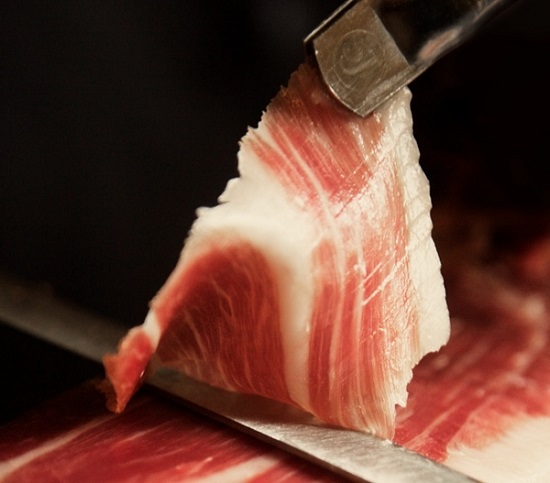
Buying a Cinco Jotas ham or shoulder is a culinary event that deserves to be treated with the utmost respect. The price of Cinco Jotas ham reflects a luxurious experience, so its slicing and storage must be optimal. To enjoy it in all its splendor, it should be hand-carved into very thin, almost translucent slices that fit whole in the mouth.
The slicing should be done at a serving temperature of around 20-24°C, when the fat begins to render its moisture and release all its volatile aromas.
To preserve the cut at home once you’ve started eating it, the ideal way is to cover the cut area with the thin slices of white fat that were removed at the beginning, and then cover everything with a clean, opaque cotton cloth. This prevents the meat from drying out in contact with the air and preserves its original juiciness. Enjoying a slice of Cinco Jotas, accompanied by a good fino sherry, a manzanilla, or a brut nature cava, is a sensory journey straight to the heart of the Andalusian pastureland that no food lover should miss.